Website Vulnerability Scanner
web-vuln-scanner is a free, open-source site vulnerability scanner and API security CLI and desktop GUI written in Rust.
Run read-only checks for TLS 1.0 to 1.3, OWASP security headers, OpenAPI specs, leaked secrets, JS source maps, exposed deployment files, and DNS hygiene locally or inside CI/CD with SARIF 2.1.0.
rustls with zero OpenSSL dependency.
Quick start
# Install via Homebrew (macOS/Linux), Cargo, Scoop (Windows), or Docker
brew install websecaudit/tap/web-vuln-scanner
cargo install website-vulnerability-scanner
docker run --rm ghcr.io/websecaudit/website-vulnerability-scanner https://example.com

# Scan any website or staging URL in the terminal
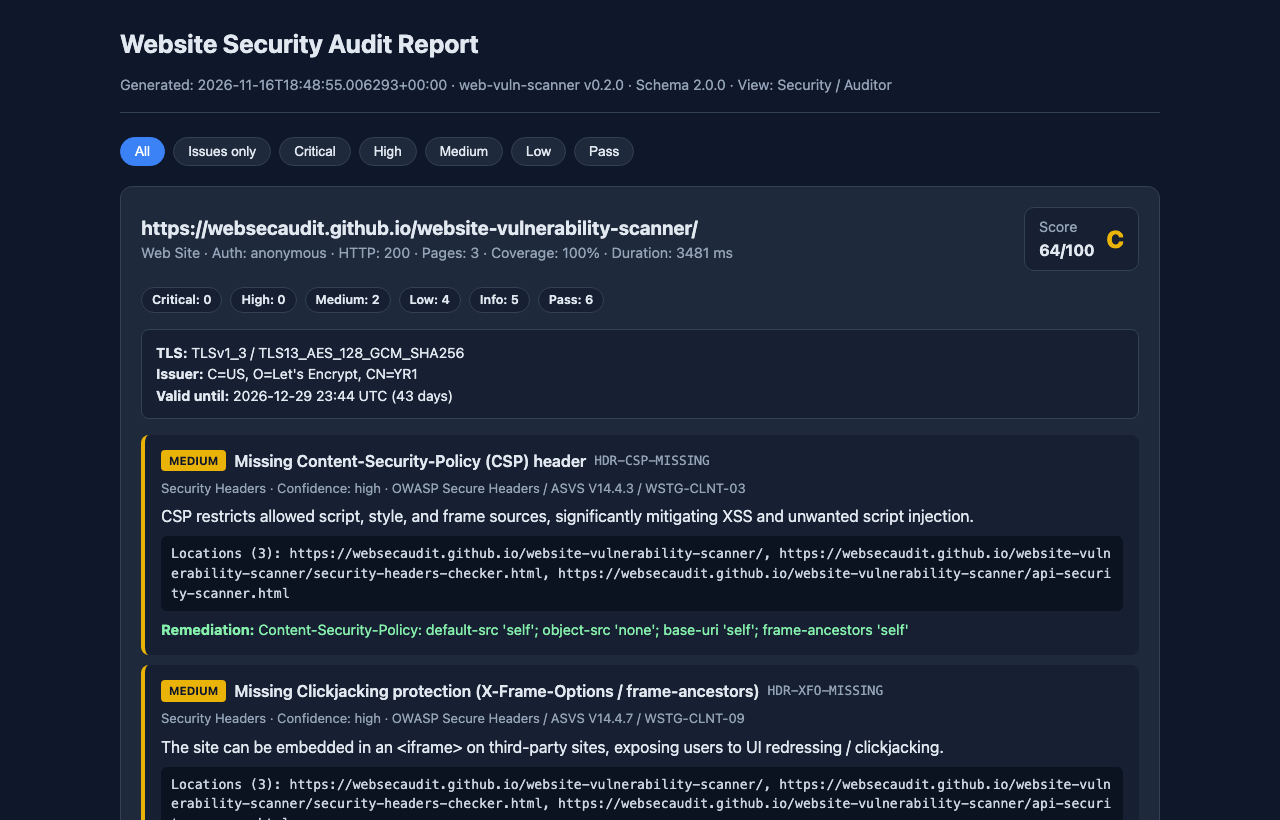
web-vuln-scanner https://example.com --html report.html --sarif results.sarif

# Audit an API with its OpenAPI 3.0 spec and generate Nginx config fixes
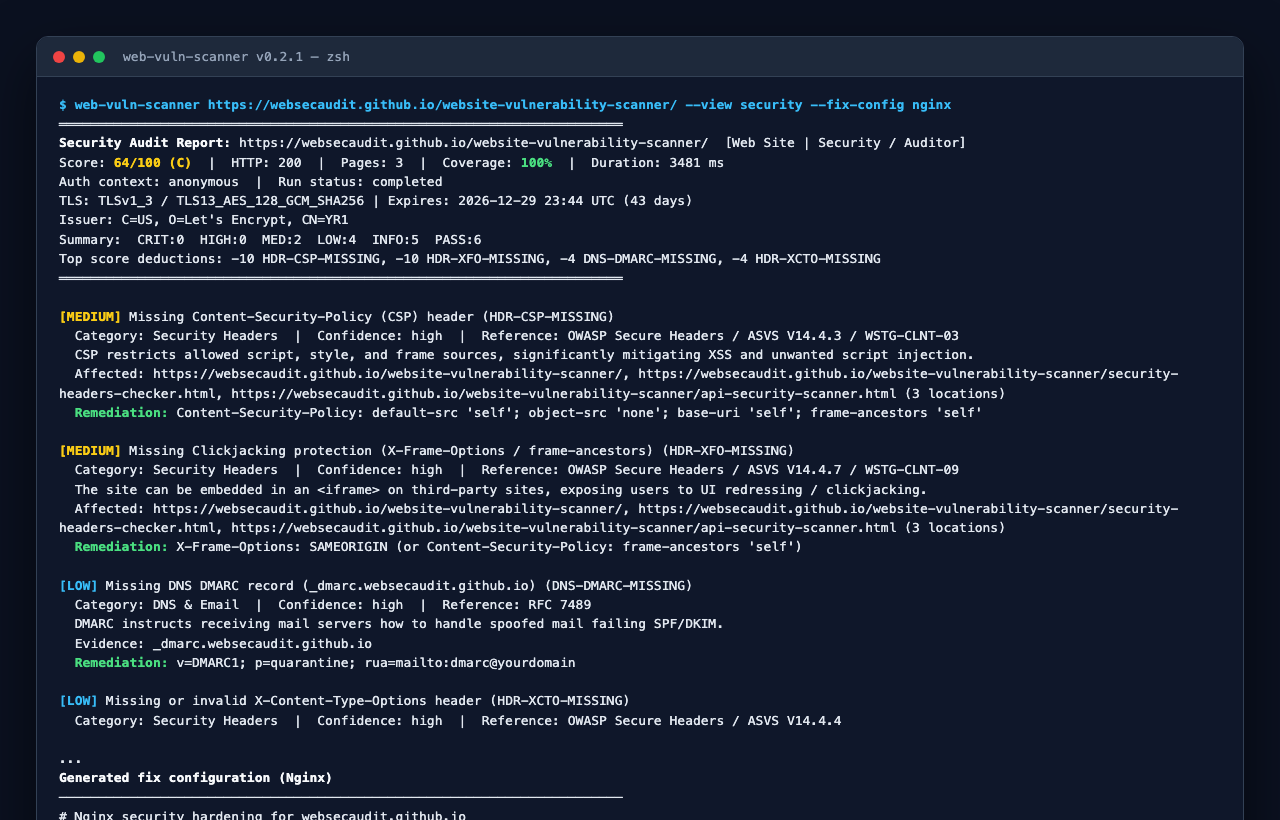
web-vuln-scanner https://api.example.com --profile api --openapi openapi.json --fix-config nginx

# Enforce a baseline gate in CI/CD (exits with code 2 on new or worsened findings)
web-vuln-scanner https://example.com --baseline prev.json --fail-on-regression
Security audit guides and documentation
Explore detailed check references, rule IDs, CLI flags, and server fix examples across all 15 audit guides:
Headers and server hardening
OWASP security headers checker
Checks HSTS, CSP, X-Frame-Options, Referrer-Policy, Permissions-Policy, COOP, and CORP.
Content Security Policy checker and generator
Detects unsafe-inline, unsafe-eval, wildcard sources, and missing base-uri directives.
HTTP cookie flag checker
Flags missing Secure, HttpOnly, SameSite=None without Secure, and caching gaps.
Nginx, Caddy, and Apache security config generator
Auto-generates targeted Nginx, Caddy, and Apache snippets from live scan findings.
API and client runtime checks
OpenAPI and REST API security scanner
Audits OpenAPI specs, anonymous access parity, JWT alg:none, and API response leaks.
CORS misconfiguration scanner
Detects arbitrary origin reflection, wildcard policies, and Allow-Credentials risk.
Frontend secret leak and JWT checker
Detects redacted AWS, GitHub, Stripe, Slack, PEM keys, DB URIs, and weak JWTs.
Outdated JavaScript libraries and source map audit
Matches jQuery, Lodash, Bootstrap, Axios, and others against CVEs and checks SRI.
TLS, exposure, and DNS
TLS certificate and HSTS configuration checker
Validates trust chain, SAN, expiry dates, HTTP redirects, HSTS, and TLS 1.0/1.1.
Exposed files and Git metadata scanner
Detects .git, .env, docker-compose, phpinfo, and directory listings without SPA noise.
DNS CAA, SPF, and DMARC checker
Audits CAA (RFC 8659), SPF (RFC 7208), and _dmarc TXT records (RFC 7489).
CI/CD, SARIF, and hardening
GitHub Actions SARIF security audit
Run scheduled or PR audits with websecaudit/website-vulnerability-scanner and upload SARIF.
OWASP ASVS and WSTG automated checks
Maps findings to OWASP ASVS and WSTG with CheckOutcome coverage accuracy.
Security baseline diffing in CI pipelines
Distinguishes new, worsened, resolved, and unverified findings with --baseline.
CLI reference and comparison with ZAP and Nuclei
All CLI flags, --rules JSON schema, exit codes, and when to pair with ZAP or Semgrep.
Screenshots
CLI audit and Nginx fix snippet
Standalone HTML audit report
Comparison against active DAST and SAST
| Capability | web-vuln-scanner | Active DAST (ZAP / Nuclei) | SAST (Semgrep / CodeQL) |
|---|---|---|---|
| Safe on production without DB writes | Yes (non-destructive) | Requires isolated staging | Yes (source code) |
| Headers, TLS, DNS, CORS, cookies, and server fixes | Yes, with Nginx/Caddy/Apache snippets | Partial (no server config gen) | No |
| OpenAPI spec and anonymous access verification | Yes (--openapi) | With setup | Limited |
SARIF 2.1.0 and baseline diff (unverified tracking) | Yes | Varies | Yes |
| Active SQLi / XSS / RCE fuzzing | No (excluded for live site safety) | Yes | Static taint rules |